In the rapidly evolving fields of computational biology and drug design, mastering Molecular Dynamics (MD) simulations can open doors to groundbreaking research. This 3-day hands-on training course using GROMACS equips students and professionals with essential knowledge and practical skills. Whether you’re exploring protein structures or designing new drugs, you’ll gain the tools to simulate molecular behaviors at an atomic level.
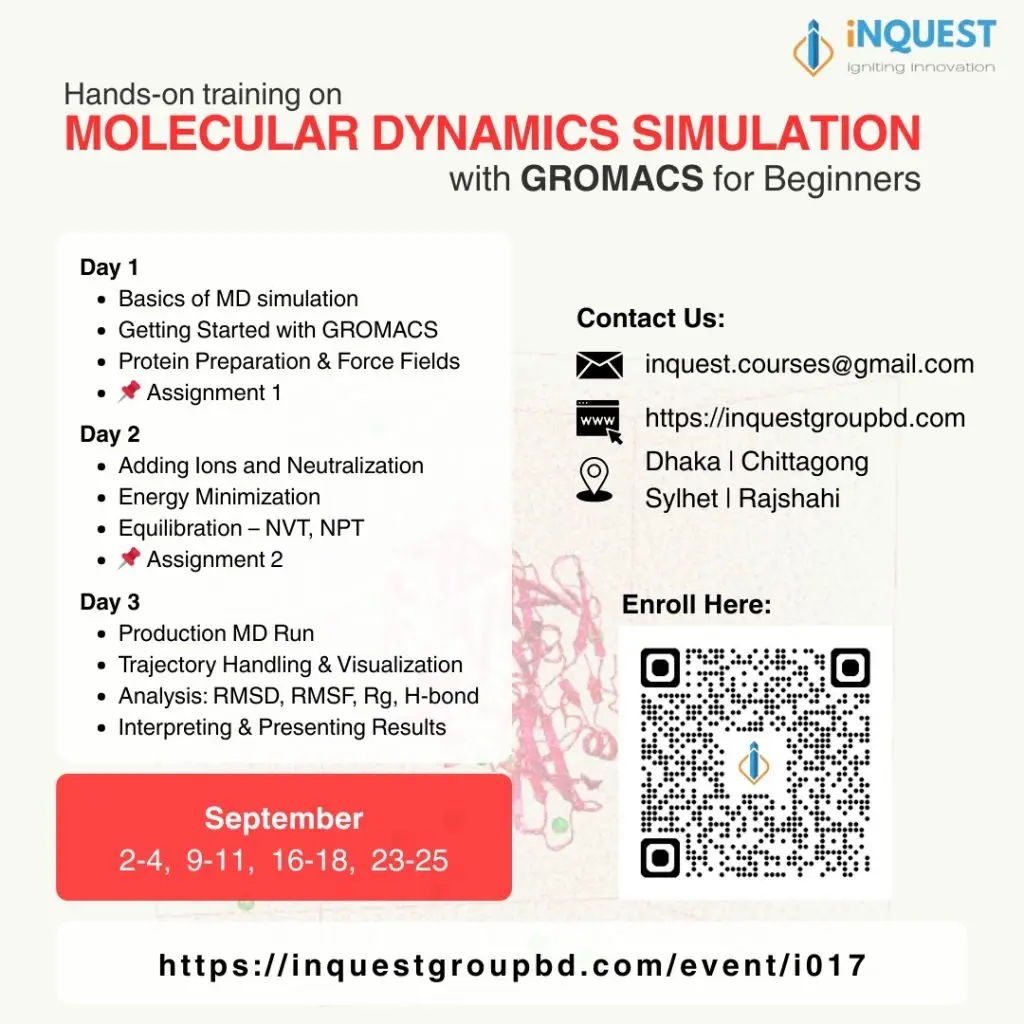
Day 1: Building the Foundations and Setting Up Your System
The course kicks off with a deep dive into the basics of MD simulations. You’ll start by understanding the core theory and principles, including how atoms, molecules, and force fields interact. Discover the wide-ranging applications of MD in structural biology and drug design, from predicting protein folding to screening potential drug candidates.
Next, you’ll explore the typical workflow of an MD simulation. This includes key steps like system preparation, energy minimization, equilibration, production runs, and result analysis. You’ll also learn about the timescales involved and the inherent limitations of these simulations, ensuring you approach them with realistic expectations.
Getting hands-on with GROMACS is a highlight of Day 1. You’ll learn why GROMACS is a top choice for MD simulations, its advantages, and real-world applications. The session covers installation in a Linux environment, essential file types, commands, and the overall workflow to get you up and running.
Finally, you’ll tackle protein preparation. This involves downloading structures from the RCSB Protein Data Bank (PDB), cleaning them by removing unnecessary waters or ligands, selecting appropriate force fields such as CHARMM, AMBER, or OPLS, and setting up a solvated system with a water box.
Hands-On Practice: Assignment 1
To reinforce your learning, Assignment 1 challenges you to prepare a protein PDB file, apply a force field, and generate a solvated system complete with .gro and .top files. You’ll submit your input and output files, solidifying your grasp on the initial setup process.
Day 2: Stabilizing Your Simulation Through Minimization and Equilibration
Building on Day 1, the second day focuses on stabilizing your molecular system. You’ll begin by learning the importance of neutralization and how to add ions like Na+ and Cl– using GROMACS tools to balance charges.
Energy minimization comes next, where you’ll run simulations with the mdrun command and analyze convergence through energy plots, ensuring your system is at a stable low-energy state.
The session then shifts to NVT equilibration, maintaining constant volume and temperature. You’ll explore coupling methods like Berendsen or V-rescale and monitor temperature stability to prepare the system for realistic conditions.
Wrapping up Day 2 is NPT equilibration, which adds constant pressure and temperature control. Using techniques like Parrinello-Rahman coupling, you’ll track pressure and density to achieve a fully equilibrated system.
Hands-On Practice: Assignment 2
Assignment 2 puts your skills to the test by having you run energy minimization, followed by NVT and NPT equilibrations on a solvated lysozyme protein. Submit your log files along with plots for energy, temperature, and density to demonstrate your progress.
Day 3: Running Production Simulations and Analyzing Results
The final day brings everything together with production runs and in-depth analysis. You’ll set up MDP parameters for a production MD simulation and execute a short demo run of 1–2 nanoseconds, simulating real molecular dynamics.
Trajectory handling is key here—learn to convert files like .xtc, .trr, or .pdb, and visualize protein motions using powerful tools such as VMD or PyMOL for an intuitive understanding of dynamic behaviors.
Dive into basic analysis techniques, including calculating Root Mean Square Deviation (RMSD), Root Mean Square Fluctuation (RMSF), radius of gyration, and hydrogen bond interactions to quantify structural changes.
The course concludes with interpreting and presenting your results. You’ll generate combined plots and learn to avoid common pitfalls in MD interpretation, ensuring your findings are robust and insightful.
Achieving Mastery: The Final Outcome
By the end of Day 3, you’ll have completed a full MD workflow on a chosen protein—from raw PDB file to production simulation and basic analysis plots. This capstone experience leaves you confident in applying these techniques independently.
Course Details and Logistics
Designed for accessibility, the course spans 3 days with 4 hours each day, divided into 12 one-hour modules, plus two practical assignments. Sessions will be held in multiple locations: Dhaka, Chittagong, Rajshahi, and Sylhet. Fees are affordable at 2200 Taka for students and 4200 Taka for professionals, making it an excellent investment in your career.
How to Join and Get in Touch
Spots are limited—we’ll select the first 10–15 participants based on your form responses. Fill out the application form carefully to secure your place. For any queries, email inquest.courses@gmail.com with the subject “MD Simulation Course.” Don’t miss this opportunity to elevate your expertise in computational biology!